

Player Roles: How to find the right type of player for your team?
In the summer of 2019, FC Barcelona acquired Frenkie de Jong from Ajax for a fee of €75 million, hoping that the Dutchman would fill the void that Xavi and Iniesta had left several years earlier. Although De Jong often appeared on the team sheet throughout the 2019/2020 season, the midfielder failed to replicate his Ajax form at the Camp Nou. De Jong found himself playing close to the opposition goal, often making runs beyond the Barcelona forwards, while he had mostly impressed from a much deeper role at Ajax the previous season. Clearly, the young Dutchman was unfamiliar with the role that he was tasked with in the Barcelona midfield.

Date

To assess whether a transfer target would suit the team’s playing style, a scout needs to know about the playing style of the player. Since the playing style reflects the actions that the player is used to perform, it informs the scout, for instance, whether the player tends to perform forward runs or prefers to remain deeper. To support scouts in addressing this challenge, the SciSports Platform offers the Playing Style module that provides insights into a player’s playing style with respect to 22 predefined roles. The roles have been established in close collaboration with football practitioners and were inspired by the Football Manager games. The Playing Style module presents the correspondence between the player’s playing style and the roles relevant to the player’s position in a season. In case of De Jong, the Dutch midfielder primarily identified as a Deep Lying Playmaker in the 2018/2019 Dutch Eredivisie season and as an Advanced Playmaker in the 2019/2020 Spanish LaLiga season.
Approach
The Playing Style module in the SciSports Platform aims to distinguish between the playing styles of players who play in a similar position. In order to do so, the Playing Style module presents the correspondence between each of the relevant roles for a particular position and the player’s playing style in a particular season. For instance, a central midfielder could be a Ball Winning Midfielder such as N’Golo Kanté or a Deep Lying Playmaker such as Frenkie de Jong. For each of the 22 predefined roles, we established 5 to 8 requirements that a player needs to meet in order to identify with that role. The more requirements a player meets, the higher the correspondence between the player’s playing style and the role is.
The requirements for each role can be seen as a number of boxes that a player can check. When a central midfielder performs at least 44.7 build-up passes per match, he ticks one of the boxes of the Deep Lying Playmaker role. When the player also performs at least 7.4 passes into the final third, he ticks another box, so his relation to the Deep Lying Playmaker role will go up. When we consider Frenkie de Jong at Ajax again, he is considered a Deep Lying Playmaker because he performed 62.2 build-up passes and 11.5 passes into the final third per match, and also met most of the other requirements.
Establishing role requirements
The requirements are selected in collaboration with football practitioners and the data for 1,235 illustrative examples for the 22 player roles that were obtained from a panel of football experts. The requirements exactly capture the different actions that are characteristic for the different roles. These actions include actions in a high defensive line, low tempo build-up passes, counterpressing actions, passes into the final third, ball receptions in the halfspaces, shots from close range, cross claims by a goalkeeper and many more. The complete set of actions, of which many can also be found in the detailed Performance module of the SciSports Platform, capture actions everywhere on the pitch, both when a player is in possession of the ball and not in possession of the ball.
The requirements are designed to capture the typical actions that describe each role. To do so, the requirements exist of two parts. One part is the type of action, which should be illustrative of the role. For example, overlapping runs on the flank are not the kind of actions to judge central midfielders on, but passes into the final third are. The second part is a threshold on the number of times the action should be performed to make the player identify more with the role. A player needs to perform a minimal number of passes into the final third to meet the requirement for Advanced Playmaker, but one of the requirements for the Ball Winning Midfielder role is that he should not perform too many. This way, the thresholds for the number of actions are the values that optimally distinguish between roles, so there is as little overlap as possible. This approach ensures that the player only qualifies when he performs relevant actions and performs them the right number of times too.
The resulting set of requirements captures the playing style of players regardless of their performance or level. We purposely only measure the number of actions, without considering their outcome. This is important because, for example, the result of a cross does not depend on the tendency of the player to perform crosses. Therefore, the shown role score is purely a reflection of the player’s style, which enables us to rate players of different levels on the same scale.
Assigning roles to players
We compute whether a player meets the requirements of each role by automatically analyzing play-by-play match event data. In order to provide representative player role ratings for a player at each point in time, we restrict our analysis to the matches that the player played in each season. We determine player roles scores separately for each position, where 3 to 5 unique roles are considered per position. So for players who played on multiple positions during the season, we consider each position independent of each other. Then we count the number of requirements the player meets for each of the relevant roles. This is done by counting how often the player performs the relevant actions of each role, on average per match. These numbers are then compared to the thresholds of the corresponding actions, leading to a number of thresholds of relevant actions that are reached. We then convert this number to a percentage that reflects the proportion of requirements met on a particular role. When a player has a score of 80% or higher he is considered to have fulfilled that role.
The role scores are visible in the Playing Style module of the SciSports platform, and in the Player List it is possible to filter on the roles that a player has fulfilled. We update the player role scores after each match and start displaying them after the player has reached the minimum threshold of 450 minutes on a position in a season. The more minutes a player plays, the more certain we are that the role reflects the true playing style of the player. After 900 minutes, players have shown their actions consistently in many matches. Then it is likely that their role assignment will not change much anymore.
Use cases
The SciSports Platform allows users to scout interesting players based on data collected during matches. The available filters for SciSkill, Potential, market value, age and other variables enables users to reduce the list of players to a shortlist in an instant. The Playing Style module takes the filter capabilities of the platform one step further. The module provides insights into which roles a player has fulfilled per position in a season and also enables users to find players who are similar to a reference player in terms of playing style. Besides the filters on quality and position, this additional filter reduces the number of shortlisted players even further and enables scouts to spend more time on video analysis and watching players live in action. In sum, all of these functionalities help assist users in their daily routine to work in a more efficient way throughout the player recruitment process.
Using player roles for player flagging
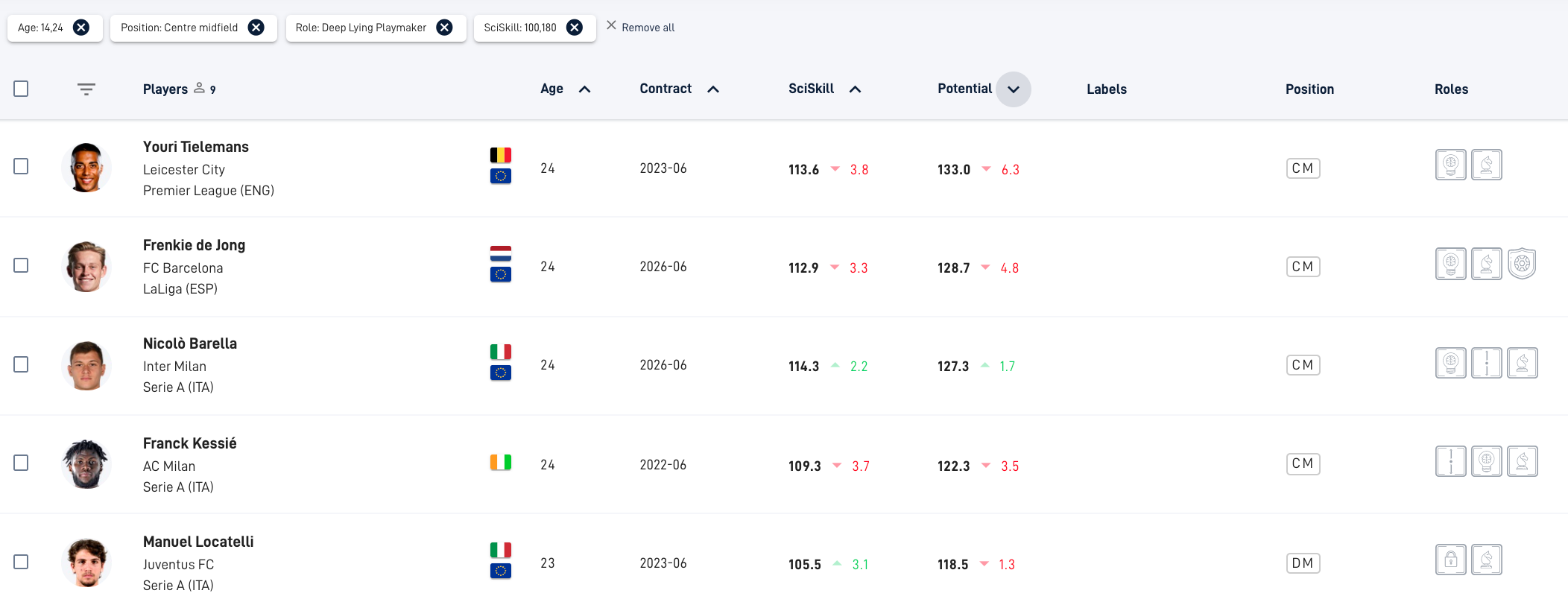
As an example, we show how the Playing Style module can help Bayern Munich in finding a new central midfielder. Given Thiago Alcantara’s departure to Liverpool in the 2020 summer transfer window, we will search for a player who identifies as a Deep-Lying Playmaker. Based on the level of Bayern Munich’s current midfielders, we also set the SciSkill filter to a minimum of 100, to not only filter on style but also on quality. Finally, to find players who can become part of a long-term squad, we also filter out players over the age of 24. This leaves the scout with a small list of players with the playing style that Hansi Flick may consider. Among the listed players is Julian Brandt, who has shown at Borussia Dortmund that he performs the type of actions that are required for a Deep-Lying Playmaker often enough. This shows how the Playing Style module provides the functionality to quickly learn about the playing style of interesting players to scout in more detail.
Using player roles for similar searches
An effective way of making player searches both focussed and accurate is through the similarity search filter. By ranking players in terms of similarity percentage, users are able to find specific types of players based on their role rather than quality. This method allows for users to carry out their clear vision of what they want from a specific position.
In the case below, for example, we have set the filters to find a right back similar to Kyle Walker at Manchester City. For this practice case, we act as a Championship club looking for players who have the SciSkill Potential to play for a mid-table Championship side.
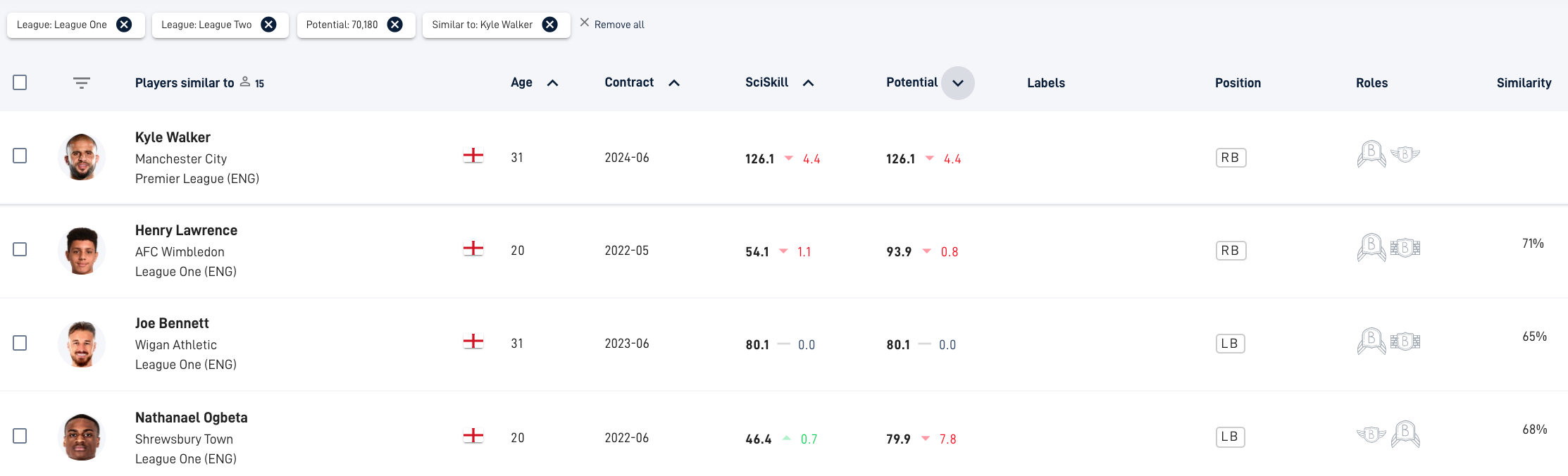
Through detailed use of both the SciSkill index and similarity function, we are able to quickly draw up a list of players who have similarities to Walker in terms of playing style – as indicated by a percentage on the right-hand side of the search.
Conclusion
The Player Roles module extends the search capabilities of the SciSports platform. It enables users to find players who are similar to a certain reference player in terms of playing style in an intuitive manner – not only does it add context to a player’s profile but it does so in a quick and efficient manner. The additional filter reduces the number of shortlisted players even further, add player-by-player comparisons and enables scouts to spend more time on video analysis and viewing live footage of individual players.
